



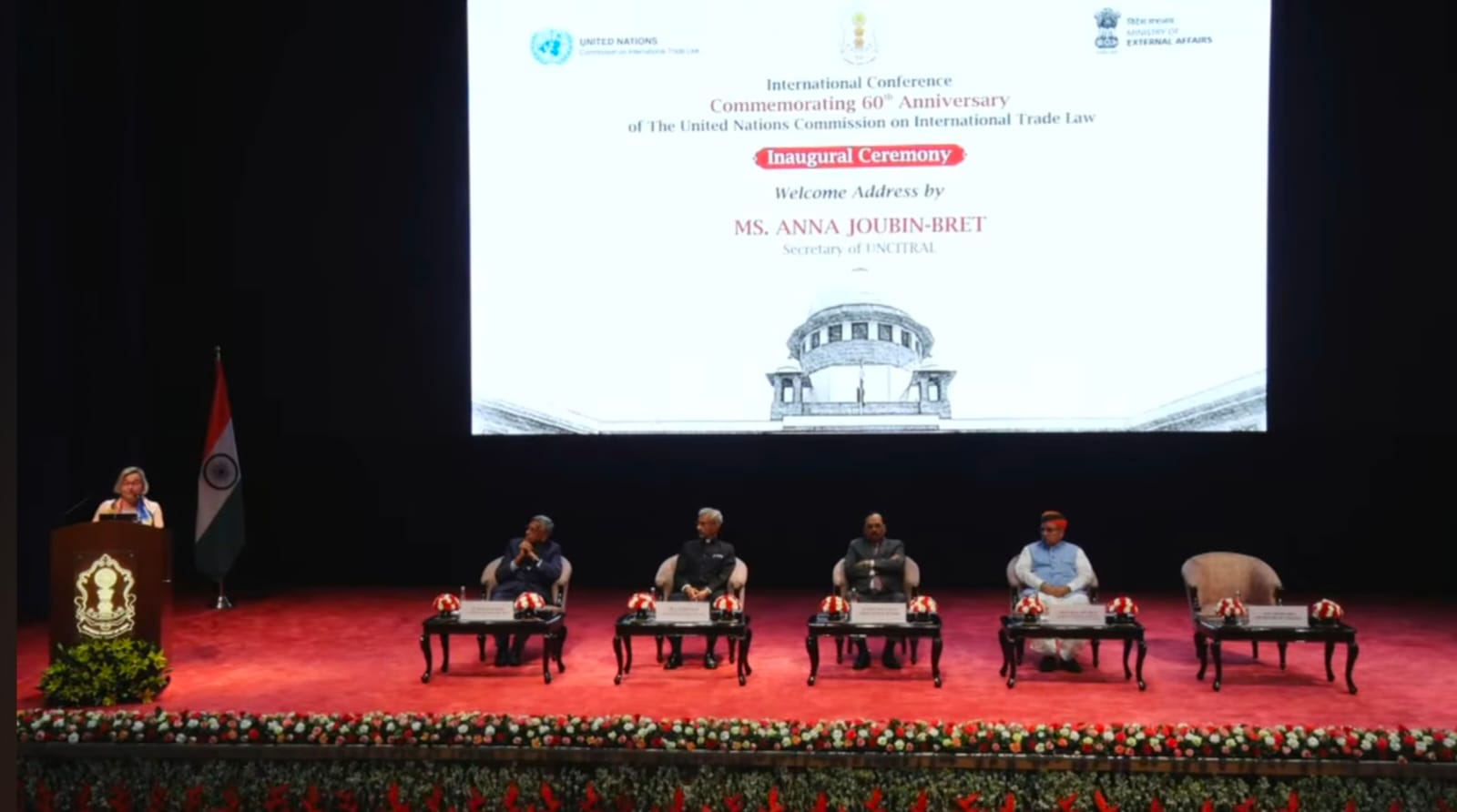
The Supreme Court of India, working with the Ministry of External Affairs and UNCITRAL, opened an international conference on 24th July marking UNCITRAL's 60th anniversary. Judges, policymakers, diplomats, legal scholars and practitioners from India and abroad came together to discuss where international commercial law, arbitration, mediation, digital trade and cross-border dispute resolution are headed next. The inaugural session brought together UNCITRAL Secretary Anna Joubin-Bret, Attorney General for India R. Venkataramani, Union Minister of State (Independent Charge) for Law and Justice Shri Arjun Ram Meghwal, External Affairs Minister Dr. S. Jaishankar and Chief Justice of India Surya Kant. The event marked India's standing as one of the few continuous members of the Commission since 1966 and set a forward-looking agenda built around digitalization, mediation and inclusive legal frameworks.
Ms. Anna Joubin-Bret (Secretary, UNCITRAL) used her remarks to walk through the Commission's recent legislative work rather than its history. She introduced the AKA Convention, the UN Convention on Negotiable Cargo Documents adopted in 2025, which lets goods moving by road, rail, air or sea be represented by a single negotiable document in paper or electronic form, built to make financing easier and customs clearance faster. She pointed to the Commission's Dispute Resolution in the Digital Economy project, under which arbitral awards can no longer be refused enforcement purely because they exist in electronic form. And she flagged progress in Working Group III, where the statute for an Advisory Center on International Investment Dispute Resolution has now been finalised, built to support developing and least-developed nations in investor-state disputes.
Shri R. Venkataramani (Attorney General for India) called UNCITRAL the "principal architect" of global trade's legal infrastructure. He argued the Commission has pulled trade law drafting out of the traditional financial centers, letting countries from the Global South contribute to the rules rather than just operate under them. He also pointed to the Commission's work putting electronic communications and signatures on the same legal footing as paper, a principle now built into digital trade laws across more than 100 jurisdictions.
Shri Arjun Ram Meghwal (Minister of State for Law and Justice) placed India's legal evolution against the backdrop of Industry 4.0 and the Viksit Bharat 2047 target, citing the Mediation Act 2023, the India International Arbitration Center Act 2019 and the recent amendments to the Arbitration and Conciliation Act as the steps making India a serious contender as a global dispute resolution hub. He called legal certainty and speedy justice "indispensable pillars" for economic growth, arguing that delays in the justice system hit business confidence and innovation directly.
Dr. S. Jaishankar (Minister of External Affairs) spoke to the geopolitics of the moment, arguing that amid supply chain disruption, nations need a rules-based architecture that keeps trade and contract enforcement working across borders. He said UNCITRAL's next chapter has to make trade law act as a "leveler," closing the gap between developed and developing economies rather than widening it.
Chief Justice of India Surya Kant's keynote reached back to the ancient dockyard at Lothal as proof that commerce has always run on mutual trust. He described the judiciary as a lighthouse, not steering every ship but giving parties the legal foundation and confidence to navigate their own course. He made mediation's case directly against arbitration: arbitration produces a winner and a loser, mediation lets parties preserve the commercial relationship and keep doing business together. He pointed to the Supreme Court's own digital push, including the National Judicial Data Grid and draft AI regulations, as proof of India's commitment to modernising its justice system.
The session closed on three priorities for what comes next: working out the legal questions raised by automated contracts and digital assets, pushing the Mediation Act 2023 and UNCITRAL's mediation standards as the route to resolving cross-border disputes without wrecking business relationships, and folding climate-sensitive investment into international commercial frameworks. The room agreed that as the center of economic gravity keeps shifting, a rules-based system matters more, not less, so that commercial disputes stay "mere interruptions to trade rather than obstacles to it."